Levittown Ny Refused to Sell to Black Families
LONG ISLAND, New York — After William "Bill" Levitt fought aslope Black soldiers as a Navy lieutenant in Globe War 2, he returned domicile to pioneer the American suburb. In dissimilarity to the nominal racial integration of the Navy, even so, Blacks were banned from living in Levitt's ticky-tacky neighborhoods.
With Jewish roots in Austria and Russia, the Levitt family did for houses what Henry Ford did for automobiles. To build Levittown on Long Island, their first successful suburb, Levitt & Sons deployed a high-tech 26-step procedure. The firm's methods and policies were imitated in thousands of suburbs all over the country.
Betwixt 1947 and 1951, Levittown's original "footprint" was completed with 17,000 houses, several shared swimming pools, and fenceless yards that encouraged children to roam.
"But I'chiliad not here just to build and sell houses," said Levitt in a 1952 interview conducted while the adjacent Levittown — in Pennsylvania — was going up. "To be perfectly frank, I'm looking for a little glory, too. It'southward only human. I desire to build a town to be proud of," said Levitt.
Back on Long Island, Levitt'south "glory" meant that residents' preference for their boondocks to be named Island Trees was trumped by Levitt'south self-applause. The builder did, however, permit Levittown'south high schoolhouse to be named Island Trees.
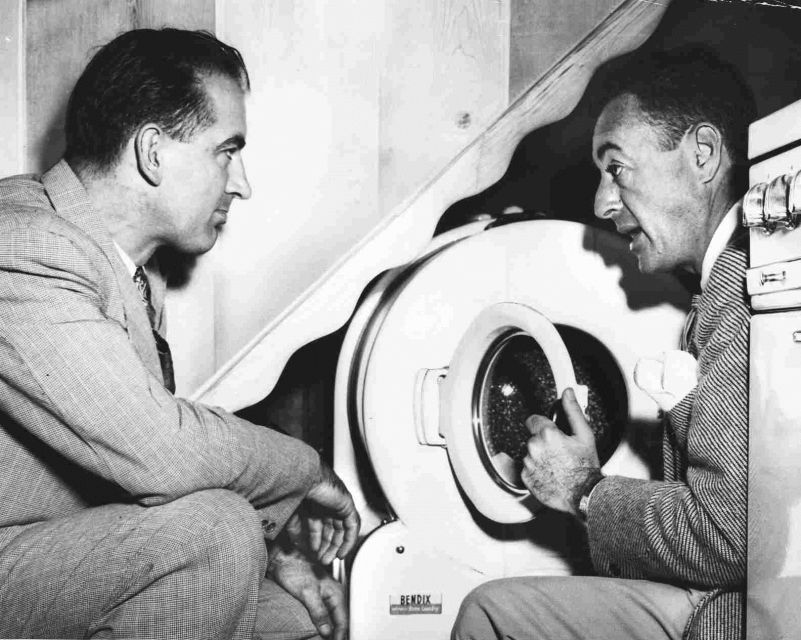
William Levitt shows Senator Joseph McCarthy a washing machine in Levittown, New York (public domain)
In New York and Pennsylvania, "Levittown" became synonymous with mass-produced suburbia. Cheers to the post-war GI Pecker, veterans could purchase an appliance-filled house for a very small down-payment — unless they were Black.
In all of Levitt'southward communities, including New Bailiwick of jersey's Willingboro, the firm enforced policies designed to proceed Blacks from buying houses. Levitt too allowed his upscale Strathmore community, on Long Island, to proceed Jews out.
Near notoriously, a few miles away from Strathmore in Levittown, "Clause 25" of the housing agreement forbade houses "from being used or occupied past any person other than members of the Caucasian race."
One year into the life of Levitt'southward "Clause 25," the US Supreme Court ruled that racially restrictive covenants violated the 14th Subpoena. Although anti-Black clauses could no longer be inserted into contracts after 1948, Levitt continued to squash attempts to racially integrate his towns.

Protesters in Levittown, New York, in 1953 (public domain)
"The Negroes in America are trying to exercise in 400 years what the Jews in the world have not wholly accomplished in half-dozen,000 years," wrote Levitt, who was sued several times for his racial policies.
"Every bit a Jew, I take no room in my mind or heart for racial prejudice," wrote Levitt. "But I have come to know that if we sell i house to a Negro family, so 90 or 95 percent of our white customers volition not purchase into the community… We can solve a housing problem, or we can effort to solve a racial trouble, but we cannot combine the two," wrote Levitt.

Primeval phase of Levittown, New York (public domain)
Half dozen years later on the completion of Long Island's Levittown, the crusade against Levitt'south racial policies was fought in forepart of a house in Levittown, Pennsylvania.
'Crisis in Levittown, PA'
The "Caucasian-merely" policy of Levitt'southward developments was challenged in the Levittown built north of Philadelphia, where the community's gently-sloped, winding lanes were named for flowers and trees.
In August 1957, a Black family moved into the all-white suburb. William Myers was a veteran and graduate student in engineering science, and his wife Daisy was also a college graduate. Along with their 3 children, the Myers moved into a three-sleeping room house.

William Myers is served coffee by his wife, Daisy, in their new dwelling in Levittown, Penn., Aug. 19, 1957 (AP Photo/Sam Myers)
Within hours of the family unit's arrival, hundreds of people gathered outside the house to shout their disapproval. All over town, rumors swirled about "outside groups" sponsoring the Myers's motility to Levittown, including "the NAACP, the Jews, and the Reds."
The "crunch in Levittown" made headlines around the earth. A group chosen "The Levittown Betterment Commission" demanded the Myers family be removed and a rock was thrown through the forepart picture window.
Throughout the crisis, a Jewish couple — Bea and Lewis Weschler — worked with other Levittown families to help the Myers. In fact, a coalition of neighbors had been organizing for six weeks prior to the Myers' move-in day, in lodge to coordinate a response to the predictable unrest.

Protesters outside the Myers dwelling house in Levittown, Pennsylvania, Baronial 20, 1957 (public domain)
In an account of Levittown's desegregation written past son Nick Weschler – who was 10 at the fourth dimension — the terrorization of the Myers family and their allies went on for months. For example, the business firm behind the Myers was purchased and turned into the "Canis familiaris Hollow Social Social club," with slavery spirituals blasted from speakers day and night.
The Weschler family and their largely Quaker and Protestant co-activists were targeted with non-stop prank calls and threats, including "KKK" scrolled onto the side of the Weschler business firm in red letters. A note fastened for "Mr. W." urged the family "to pull out while you can."
During the Ku Klux Klan-fueled campaign in Levittown, crosses were burned on the properties of half a dozen families that supported the Myers, including on the Weschler lawn. At one signal, a police officer was seriously injured with a rock.

Lewis Weschler outside his house in Levittown, Pennsylvania, 1957 (public domain)
Throughout the ordeal, state and local police were unable to curtail the harassment. Only afterward the victimized families went to the State House and threatened to leave Levittown, was serious action taken. A permanent injunction was placed on seven of the worst offenders, and the violence ended with a tacit victory for integration.
William Levitt kept Blacks out of his towns for equally long as he could, only a coalition of faith-based neighbors managed to reverse that racist policy in Pennsylvania. The tactics deployed past activists in Levittown — including "fact-finding" groups to squash rumors — were repeated a few weeks later in Piffling Rock, Arkansas.

Protest near Levittown, Pennsylvania, to keep Black families from purchasing houses, 1957 (public domain)
"When yous find there are no more areas to which a white person can move without having a Black family, that volition be the best end in that location could be to segregation," said a pro-integration Levittown homeowner and mother in the 1957 documentary, "Crisis in Levittown, PA."
60-four years afterwards the boxing for integration, the Pennsylvania town of 52,000 is 9-tenths white. According to U.s. Census projections, the country will get "minority white" in 2045, with whites comprising 49.7% of the population.
Source: https://www.timesofisrael.com/how-americas-jewish-king-of-the-suburbs-kept-blacks-out-of-suburbia/
0 Response to "Levittown Ny Refused to Sell to Black Families"
Post a Comment