5 Pictures Including 1 When It Is a Baby and 1 When It Is an Adult Zebra
| Zebra Temporal range: Pliocene to recent | |
|---|---|
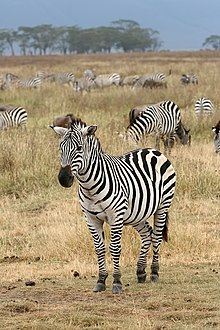 | |
| A herd of plains zebras (Equus quagga) in the Ngorongoro Crater in Tanzania | |
Scientific classification  | |
| Kingdom: | Animalia |
| Phylum: | Chordata |
| Class: | Mammalia |
| Gild: | Perissodactyla |
| Family: | Equidae |
| Genus: | Equus |
| Subgenus: | Hippotigris C. H. Smith, 1841 |
| Species | |
| †East. capensis | |
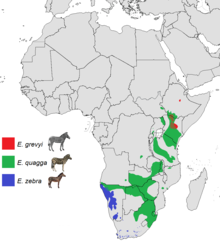 | |
| Modern range of the three living zebra species | |
Zebras (, ) (subgenus Hippotigris ) are African equines with distinctive black-and-white striped coats. There are 3 living species: the Grévy's zebra (Equus grevyi), plains zebra (E. quagga), and the mountain zebra (Due east. zebra). Zebras share the genus Equus with horses and asses, the iii groups beingness the merely living members of the family Equidae. Zebra stripes come in different patterns, unique to each individual. Several theories have been proposed for the function of these stripes, with most evidence supporting them as a deterrent for bitter flies. Zebras inhabit eastern and southern Africa and tin can exist found in a diverseness of habitats such as savannahs, grasslands, woodlands, shrublands, and mountainous areas.
Zebras are primarily grazers and tin can subsist on lower-quality vegetation. They are preyed on mainly past lions and typically flee when threatened but also bite and boot. Zebra species differ in social behaviour, with plains and mountain zebra living in stable harems consisting of an adult male or stallion, several adult females or mares, and their young or foals; while Grévy's zebra live alone or in loosely associated herds. In harem-holding species, adult females mate just with their harem stallion, while male person Grévy's zebras found territories which concenter females and the species is promiscuous. Zebras communicate with various vocalisations, body postures and facial expressions. Social grooming strengthens social bonds in plains and mountain zebras.
Zebras' dazzling stripes make them among the most recognisable mammals. They have been featured in fine art and stories in Africa and beyond. Historically, they have been highly sought after by exotic animal collectors, just unlike horses and donkeys, zebras accept never been truly domesticated. The International Union for Conservation of Nature (IUCN) lists the Grévy'south zebra equally endangered, the mount zebra as vulnerable and the plains zebra every bit virtually-threatened. The quagga, a type of plains zebra, was driven to extinction in the 19th century. Nevertheless, zebras tin can be found in numerous protected areas.
Etymology
The English proper noun "zebra" dates back to c. 1600, deriving from Italian, Castilian or Portuguese.[1] [2] Its origins may lie in the Latin equiferus pregnant "wild equus caballus"; from equus ("horse") and ferus ("wild, untamed"). Equiferus appears to accept entered into Portuguese as ezebro or zebro, which was originally used for a legendary equine in the wilds of the Iberian Peninsula during the Center Ages.[3] In ancient times, the zebra was called hippotigris ("horse tiger") by the Greeks and Romans.[3] [4]
The word "zebra" was traditionally pronounced with a long initial vowel, but over the course of the 20th century the pronunciation with the brusque initial vowel became the norm in the United kingdom and the Commonwealth.[5] The pronunciation with a long initial vowel remains standard in US English.[vi]
Taxonomy and evolution
Zebras are classified in the genus Equus (known as equines) along with horses and asses. These 3 groups are the only living members of the family Equidae.[vii] The plains zebra and mountain zebra were traditionally placed in the subgenus Hippotigris (C. H. Smith, 1841) in contrast to the Grévy's zebra which was considered the sole species of subgenus Dolichohippus (Heller, 1912).[8] [nine] [10] Groves and Bell (2004) placed all three species in the subgenus Hippotigris.[eleven] A 2013 phylogenetic study found that the plains zebra is more closely related to Grévy's zebras than mount zebras.[12] The extinct quagga was originally classified every bit a distinct species.[13] Later genetic studies have placed it as the same species as the plains zebra, either a subspecies or but the southernmost population.[fourteen] [15] Molecular evidence supports zebras every bit a monophyletic lineage.[12] [xvi] [17]
Equus originated in North America and direct paleogenomic sequencing of a 700,000-year-old middle Pleistocene horse metapodial bone from Canada implies a date of iv.07 one thousand thousand years ago (mya) for the most recent common ancestor of the equines within the range of 4.0 to 4.5 mya.[18] Horses split from asses and zebras around 4 mya, and equines entered Eurasia effectually iii mya. Zebras and asses diverged from each other close to ii.viii mya and zebra ancestors entered Africa effectually two.3 mya. The mountain zebra diverged from the other species around 1.75 mya and the plains and Grévy's zebra split effectually 1.5 mya.[12] [19] [xx]

Quagga mare at London Zoo, 1870, the but specimen photographed alive. This animal was historically considered a separate species but is now considered a subspecies or population of plains zebra.
The cladogram of Equus beneath is based on Vilstrup and colleagues (2013):[12]
Living species
| Name | Clarification | Distribution | Subspecies | Chromosomes | Epitome |
|---|---|---|---|---|---|
| Grévy'southward zebra (Equus grevyi) | Torso length of 250–300 cm (viii.2–nine.8 ft) with 38–75 cm (15–thirty in) tail, 125–160 cm (4.10–5.25 ft) shoulder height and weighs 352–450 kg (776–992 lb);[21] Mule-like advent with narrow skull, robust neck and conical ears; narrow striping pattern with concentric rump stripes, white belly and tail base and white margin around the muzzle[7] [22] [23] | Eastern Africa including the Horn;[22] arid and semiarid grasslands and shrublands[24] | Monotypic[22] | 46[24] |  |
| Plains zebra (Equus quagga) | Torso length of 217–246 cm (7.12–viii.07 ft) with 47–56 cm (19–22 in) tail, 110–145 cm (iii.61–4.76 ft) shoulder height and weighs 175–385 kg (386–849 lb);[21] Dumpy bodied with relatively brusque legs and a skull with a convex brow and a somewhat concave nose profile;[7] [25] broad stripes, horizontal on the rump, with northern populations having more extensive striping while populations further south have whiter legs and bellies as well every bit more brown "shadow" stripes in-between blackness stripes[7] [26] [27] [28] | Eastern and southern Africa; savannahs, grasslands and open woodlands[29] | six[11] or monotypic[xv] | 44[26] |  |
| Mountain zebra (Equus zebra) | Body length of 210–260 cm (six.ix–8.five ft) with 40–55 cm (16–22 in) tail, 116–146 cm (3.81–4.79 ft) shoulder tiptop and weighs 204–430 kg (450–948 lb);[21] eye sockets more rounded and positioned farther dorsum, a squarer nuchal crest, dewlap present nether cervix and compact hooves; stripes intermediate in width betwixt the other species, with gridiron and horizontal stripes on the rump, while the belly is white and the cage is lined with chestnut or orange[30] [vii] [31] [24] | Southwestern Africa; mountains, rocky uplands and Karoo shrubland[29] [xxx] | 2[thirty] | 32[24] |  |

Fossil skull of Equus mauritanicus

Romulus, the striped offspring of a horse mother and a zebra father
Fossil record
In improver to the 3 living species, some fossil zebras have also been identified. Equus koobiforensis is an early on zebra or equine basal to zebras institute in the Shungura Formation, Ethiopia and the Olduvai Gorge, Tanzania, and dated to around ii.three mya.[twenty] E. oldowayensis is identified from remains in Olduvai Gorge dating to i.8 mya.[32] Fossil skulls of E. mauritanicus from Algeria which date to around 1 mya appears to bear witness affinities with the plains zebra.[33] [34] E. capensis, known every bit the Cape zebra, appeared effectually 2 mya and lived throughout southern and eastern Africa.[35] [32]
Not-African equines that may accept been basal to zebras include E. sansaniensis of Eurasia (circa ii.5 mya) and E. namadicus (circa 2.5 mya) and E. sivalensis (circa 2.0 mya) of the Indian subcontinent.[20] A 2017 mitochondrial DNA study placed the Eurasian E. ovodovi and the subgenus Sussemionus lineage as closer to zebras than to asses.[36]
Hybridisation
Fertile hybrids have been reported in the wild between plains and Grévy's zebra.[37] Hybridisation has also been recorded between the plains and mount zebra, though information technology is possible that these are infertile due to the difference in chromosome numbers between the two species.[38] Captive zebras have been bred with horses and donkeys; these are known as zebroids. A zorse is a cross between a zebra and a horse; a zonkey between a zebra and a donkey and a zoni between a zebra and a pony. Zebroids are normally infertile and may suffer from dwarfism.[39]
Characteristics

As with all wild equines, zebra have barrel-chested bodies with tufted tails, elongated faces and long necks with long, erect manes. Their elongated, slender legs end in a single spade-shaped toe covered in a hard hoof. Their dentition is adjusted for grazing; they accept large incisors that clip grass blades and highly crowned, ridged molars well suited for grinding. Males take spade-shaped canines, which can be used as weapons in fighting. The optics of zebras are at the sides and far upwards the head, which allows them to see to a higher place the tall grass while grazing. Their moderately long, cock ears are movable and can locate the source of a audio.[7] [27] [31]
Unlike horses, zebras and asses have anecdote callosities but on their forepart limbs. In dissimilarity to other living equines, zebra forelimbs are longer than their dorsum limbs.[31] Diagnostic traits of the zebra skull include: its relatively pocket-sized size with a straight profile, more projected middle sockets, narrower rostrum, reduced postorbital bar, a V-shaped groove separating the metaconid and metastylid of the teeth and both halves of the enamel wall being rounded.[xl]
Stripes

Comparative analogy of living zebra species
Zebras are easily recognised past their bold blackness-and-white striping patterns. The belly and legs are white when unstriped, just the muzzle is nighttime and the skin underneath the coat is uniformly black.[41] [42] [43] Immature or foals are born with chocolate-brown and white coats, and the brown darkens with age.[25] [22] The full general design is a dorsal line that extends from the forehead to the tail. From there, the stripes stretch downward except on the rump, where they develop species-specific patterns, and virtually the nose where they curve toward the nostrils. Stripes split up to a higher place the forepart legs, creating shoulder stripes. The stripes on the legs, ears and tail are divide and horizontal. Zebras also have complex patterns effectually the eyes and the lower jaw.[41]
Striping patterns are unique to an individual and heritable.[44] During embryonic development, the stripes appear at eight months, merely the patterns may be determined at 3 to five weeks. For each species there is a indicate in embryonic evolution where the stripes are perpendicular to the dorsal and spaced 0.iv mm (0.016 in) apart. However, this happens at three weeks of development for the plains zebra, 4 weeks for the mountain zebra, and five for Grévy's zebra. The departure in timing is thought to be responsible for the differences in the striping patterns of the different species.[41]
Various abnormalities of the patterns have been documented in plains zebras. Melanistic zebras have loftier concentrations of dark stripes on the torso only depression concentrations on the legs. "Spotted" individuals display interruptions in black striping patterns.[45] There have even been morphs with white spots on dark backgrounds.[46] Striping abnormalities have been linked to inbreeding.[45] Albino zebras have been recorded in the forests of Mountain Kenya, with the dark stripes being blonde.[47] The quagga had brown and white stripes on the head and cervix, dark-brown upper parts and a white abdomen, tail and legs.[48]
Role
The function of stripes in zebras has been discussed among biologists since at least the 19th century.[49] Popular hypotheses include the post-obit:
- The crypsis hypothesis was proposed by Alfred Wallace in 1896 and suggests that the stripes allow the brute to blend in with its environment or break out its outline so predators can not perceive it equally a single entity.[50] Zebra stripes may provide particularly good cover-up at nighttime, which is when lions and hyenas are actively hunting.[51] In 1871, Charles Darwin remarked that "the zebra is conspicuously striped, and stripes on the open plains of South Africa cannot afford any protection".[52] Zebras graze in open up habitat and do not bear cryptically, being noisy, fast, and social. They do not freeze when detecting a predator. In addition, lions and hyenas exercise non appear to be able to discern stripes beyond a sure distance in daylight, thus making the stripes useless in disrupting the outline. Stripes also practise not appear to brand zebras more difficult to find than uniformly coloured animals of similar size, and predators may still be able to detect them by scent or hearing.[53] The camouflaging stripes of woodland living ungulates like bongos and bushbucks are much less brilliant and lack the sharp contrast with the background color.[54] [55] In add-on, dissimilar tiger stripes, the spatial frequencies of zebra stripes do not line up with their environment.[56] A 2014 study could not discover whatsoever correlations between striping patterns and woodland habitats.[55]

Closeup of mountain zebra stripes
- The confusion hypothesis states that the stripes confuse predators, be it by: making it harder to distinguish individuals in a group besides as determining the number of zebras in a group; making information technology difficult to determine an individual'south outline when the group flees; reducing a predator's ability to follow a target during a chase; dazzling an assailant so they accept difficulty making contact; or making it difficult for a predator to judge the zebra's size, speed and trajectory via motion dazzle. This theory has been proposed past several biologists since at least the 1970s.[57] A 2014 computer report of zebra stripes institute that the motility signals made by zebra stripes requite out misleading information and can cause defoliation via the railroad vehicle-bicycle effect or barber pole illusion. The researchers concluded that this could be used confronting mammalian predators or biting flies.[58] The apply of the stripes for confusing against mammalian predators has been questioned. The stripes of zebras could brand group size look smaller, and thus more attractive to predators. Zebras also tend to scatter when fleeing from attackers and thus the stripes could not obscure an individual's outline. Lions, in particular, appear to have no difficulty targeting and making contact with zebras when they get shut and take them by deadfall.[59] In addition, no correlations have been constitute between the corporeality of stripes and populations of mammal predators.[55]
- The aposematic hypothesis suggests that the stripes serve equally warning colouration every bit they are recognisable upward close. Biologist L. H. Matthews proposed in 1971 that the stripes on the side of the oral cavity point to the animal'due south bite. As with known aposematic mammals, zebras accept high predation pressures and brand no effort to hibernate.[60] However they are often preyed on past lions, suggesting that stripes do not deter them but may work on smaller predators. In add-on, zebras are not slow and sluggish similar known aposematic mammals.[61]
- The social function hypothesis states that stripes serve a role in intraspecific or individual recognition, social bonding, mutual grooming facilitation, or a indicate of fitness. Darwin wrote in 1871 that "a female person zebra would non admit the addresses of a male ass until he was painted so equally to resemble a zebra" while Wallace stated in 1871 that: "The stripes therefore may be of employ by enabling stragglers to distinguish their fellows at a distance".[62] Regarding species and individual identification, zebras take limited range overlap with each other and horses can recognise each other using visual cues.[63] In addition, no correlation has been found between striping and social behaviour amid equines.[55] There is also no link found between fettle and striping.[63]

Comparison of flight trajectories and contact/landings of horse flies around domestic horses (a-c) and plains zebras (d-f).[64]
- The thermoregulatory hypothesis suggests that stripes assist to control a zebra'due south body temperature. In 1971, biologist H. A. Baldwin noted that blackness stripes absorbed heat while the white ones reflected it. In 1990, zoologist Desmond Morris proposed that the stripes gear up up convection currents to absurd the brute.[65] A study from 2015 determined that environmental temperature is a strong predictor for zebra striping patterns.[66] Another report from 2019 also concluded that the stripes played a role in regulating heat. Air currents move faster over the estrus-absorbing black hairs than the white ones. At the junction of the stripes, the air swirls and cools downwards the animal. In addition, zebras appear to be able to heighten the hair of the black stripes while keeping white hair flat. During the hottest times of the solar day, the raised hair may help transfer heat from the skin to the hair surface, while during the libation early on morning, the raised black hair can trap air to prevent rut loss.[67] Others have plant no evidence that zebras accept cooler bodies than other ungulates whose habitat they share, or that striping correlates with temperature.[68] [55] A 2018 experimental study which dressed water-filled metal barrels in equus caballus, zebra and cattle hides found that zebra stripes have no upshot on thermoregulation.[69]
- The fly protection hypothesis holds that the stripes deter biting flies. Equus caballus flies, in particular, spread diseases that are lethal to equines such as African horse sickness, equine flu, equine infectious anemia and trypanosomiasis. In addition, zebra hair is shorter or the same length as the mouthparts of equus caballus flies.[55] Caro and colleagues (2019) reported this hypothesis as the "emerging consensus among biologists".[64] It was found that flies were less likely to country on black-and-white striped surfaces than uniformly coloured ones in 1930 past biologist R. Harris.[70] A 2012 written report concurred this and concluded that the stripes reflect contrasting light patterns rather than the uniform patterns these insects employ to locate food and water.[71] A 2014 study constitute a correlation between the corporeality of striping and the presence of horse and tsetse flies. Amongst wild equines, zebras live in areas with the highest wing activity.[55] Other studies have constitute that zebras are rarely targeted by these insect species.[72] Caro and colleagues studied captive zebras and horses and found that neither could deter flies from a altitude, but zebra stripes made it hard for flies to make a landing, both for zebras and horses dressed in zebra print coats.[64] A 2020 study found that zebra stripes do non dazzle or work similar a hairdresser pole against flies since checky patterns also repel them.[73] White or light stripes painted on night bodies accept as well been found to reduce fly irritations in both cattle and humans.[74] [75]
Ecology and behaviour

Mountain zebra dustbathing in Namibia
Zebras may travel or migrate to ameliorate watered areas.[25] [27] Plains zebras have been recorded travelling 500 km (310 mi) between Namibia and Botswana, the longest country migration of mammals in Africa.[76] When migrating, they appear to rely on some retentivity of the locations where foraging conditions were best and may predict conditions months after their arrival.[77] Plains zebras are more water-dependent and alive in more mesic environments than other species. They seldom wander 10–12 km (6.2–7.five mi) from a water source.[25] [27] [78] Grévy's zebras tin can survive virtually a week without water but will drink daily when it is plentiful and conserve water well.[79] [22] Mount zebras can be found at elevations of upward to 2,000 k (half-dozen,600 ft).[80] Zebras may spend seven hours a day sleeping. During the mean solar day, they sleep standing up, while at night they lie downwardly. They regularly rub against trees, rocks, and other objects and whorl around in dust for protection against flies and irritation. Except for the mountain zebra, zebras can roll over completely.[27]

Zebras swallow primarily grasses and sedges merely may likewise swallow bark, leaves, buds, fruits, and roots if their favoured foods are scarce. Compared to ruminants, zebras have a simpler and less efficient digestive system. Nevertheless, they tin subsist on lower-quality vegetation. Zebras may spend lx–lxxx% of their time feeding, depending on the availability and quality of vegetation.[7] [27] The plains zebra is a pioneer grazer, mowing downwards the upper, less nutritious grass awning and preparing the way for more specialised grazers, which depend on shorter and more than nutritious grasses below.[81]
Zebras are preyed on mainly past lions. Leopards, cheetahs, spotted hyenas, brown hyenas and wild dogs pose less of a threat to adults.[82] Nile crocodiles also prey on zebras when they near water.[83] Bitter and kicking are a zebra's defence force tactics. When threatened by lions, zebras abscond, and when defenseless they are rarely effective in fighting off the big cats.[84] The zebra can reach a speed of 68.iv km/h (42.5 mph) compared to 57.6 km/h (35.8 mph) for the lion, but maximum acceleration is respectively 18 km/h (eleven mph) and 34.ii km/h (21.iii mph). A lion has to surprise a zebra within the first six seconds of breaking encompass.[85] However, a 2018 study found that zebras exercise not escape lions by speed alone but by sideways turning, especially when the predator is close backside.[86] With smaller predators like hyenas and dogs, zebras may act more aggressively, especially in defence force of their young.[87]

Zebra species have two basic social structures. Plains and mountain zebras live in stable, closed family unit groups or harems consisting of one stallion, several mares, and their offspring. These groups have their own home ranges, which overlap, and they tend to be nomadic. Stallions form and expand their harems by recruiting young mares from their natal (birth) harems. The stability of the group remains fifty-fifty when the family unit stallion dies or is displaced. Plains zebra groups also alive in a fission–fusion society. They gather into large herds and may create temporarily stable subgroups within a herd, assuasive individuals to interact with those outside their grouping. Among harem-property species, this behaviour has otherwise only been observed in primates such as the gelada and the hamadryas birdie.[7] [27] [88]
Females of these species do good as males give them more time for feeding, protection for their immature, and protection from predators and harassment by outside males. Among females in a harem, a linear dominance hierarchy exists based on the time at which they bring together the group. Harems travel in a consistent filing lodge with the high-ranking mares and their offspring leading the groups followed by the side by side-highest ranking mare and her offspring, and so on. The family unit stallion takes up the rear. Young of both sexes leave their natal groups as they mature; females are usually herded by outside males to exist included as permanent members of their harems.[7] [27] [88]

Group of Grévy's zebras grazing
In the more arid-living Grévy's zebras, adults have more fluid associations and developed males constitute large territories, marked by dung piles, and monopolise the females that enter them. This species lives in habitats with sparser resources and continuing water and grazing areas may be separated. Groups of lactating females are able to remain in groups with nonlactating ones and usually assemble at foraging areas. The almost dominant males establish territories virtually watering holes, where more sexually receptive females gather. Subdominants accept territories farther away, well-nigh foraging areas. Mares may wander through several territories but remain in one when they have young. Staying in a territory offers a female protection from harassment by outside males, too as access to a renewable resource.[7] [27] [88]
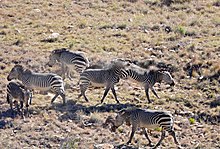
Mountain zebras quarrelling
In all species, excess males gather in bachelor groups. These are typically young males that are not yet ready to constitute a harem or territory.[7] [27] [88] With the plains zebra, the males in a bachelor group have strong bonds and accept a linear potency hierarchy.[27] Bachelor groups tend to be at the periphery of herds and when the herd moves, the bachelors trail behind.[78] Mountain zebra bachelor groups may also include young females that take recently left their natal group, as well as old males they have lost their harems. A territorial Grévy's zebra stallion may tolerate non-territorial bachelors who wander in their territory, even so when a mare in oestrous is present the territorial stallion keeps other stallions at bay. Bachelors gear up for their adult roles with play fights and greeting/claiming rituals, which make upward most of their activities.[27]
Fights between males usually occur over mates and involve biting and boot. In plains zebra, stallions fight each other over recently matured mares to bring into their group and her family stallion will fight off other males trying to abduct her. As long every bit a harem stallion is healthy, he is not usually challenged. Only unhealthy stallions have their harems taken over, and even then, the new stallion gradually takes over, pushing the one-time 1 out without a fight. Agonistic behaviour between male person Grévy's zebras occurs at the edge of their territories.[27]
Communication

Plains zebras mutually grooming
Zebras produce a number of vocalisations and noises. The plains zebra has a distinctive, loftier-pitched contact call (commonly called "barking") heard as "a-ha, a-ha, a-ha" or "kwa-ha, kaw-ha, ha, ha".[25] The call of the Grévy's zebra has been described as "something similar a hippo'southward grunt combined with a donkey's wheeze", while the mountain zebra is relatively silent. Loud snorting in zebras is associated with alarm. Squealing is usually made when in pain, but bachelors also squeal while play fighting. Zebras also communicate with visual displays, and the flexibility of their lips allows them to make complex facial expressions. Visual displays besides incorporate the positions of the caput, ears, and tail. A zebra may signal an intention to boot by laying back its ears and sometimes lashing the tail. Flattened ears, bared teeth, and abrupt movement of the heads may be used equally threatening gestures, specially among stallions.[27]
When meeting for the commencement time, or later on they have separated, individuals may greet each other by rubbing and sniffing their noses followed by rubbing their cheeks, moving their noses along their bodies and sniffing each other's genitals. They then may rub and press their shoulders against each other and balance their heads on 1 some other. This greeting is usually performed among harem or territorial males or amongst bachelor males playing.[27] Plains and mountain zebras strengthen their social bonds with training. Members of a harem nip and scrape forth the neck, shoulder, and back with their teeth and lips. Training usually occurs betwixt mothers and foals and between stallions and mares. Grooming shows social status and eases aggressive behaviour.[27] [89] Although Grévy's zebras do not perform social grooming, they do sometimes rub against some other private.[22]
Reproduction and parenting

Captive Grévy's zebras mating
Amid plains and mountain zebras, the adult females mate simply with their harem stallion, while in Grévy's zebras, mating is more promiscuous and the males take larger testes for sperm competition.[7] [90] Estrus in female zebras lasts five to ten days; physical signs include frequent urination, flowing mucus, and swollen, everted (within out) labia. In addition, females in oestrous will stand with their hind legs spread and enhance their tails when in the presence of a male. Males appraise the female'due south reproductive state with a curled lip and bared teeth (flehmen response) and the female volition solicit mating by backing in. The length of gestation varies past species; it is roughly xi–13 months, and most mares come into rut once again within a few days after foaling, depending on conditions.[27] In harem-belongings species, oestrus in a female becomes less noticeable to outside males every bit she gets older, hence contest for older females is virtually nonexistent.[25]

Mountain zebra suckling a foal
Usually, a unmarried foal is born, which is capable of running within an hour of birth.[seven] A newborn zebra will follow anything that moves, so new mothers prevent other mares from approaching their foals while imprinting their own striping pattern, olfactory property and vocalisation on them.[22] Within a few weeks, foals attempt to graze, merely may keep to nurse for eight to thirteen months.[7] Living in an arid environment, Grévy'south zebras take longer nursing intervals and do not drink water until they are 3 months quondam.[91]
In plains and mountain zebras, foals are cared for more often than not past their mothers, but if threatened by pack-hunting hyenas and dogs, the entire group works together to protect all the immature. The group forms a protective forepart with the foals in the centre, and the stallion will rush at predators that come too shut.[27] In Grévy'southward zebras, mothers may gather into small groups and leave their young in "kindergartens" guarded by a territorial male while searching for water.[91] A stallion may wait after a foal in his territory to ensure that the mother stays, though information technology may not be his.[88] Past dissimilarity, plains zebra stallions are by and large intolerant of foals that are not theirs and may practice infanticide and feticide via violence to the pregnant mare.[92]
Human relations
Cultural significance

With their distinctive blackness-and-white stripes, zebras are amongst the most recognisable mammals. They take been associated with beauty and grace, with naturalist Thomas Pennant describing them in 1781 as "the almost elegant of quadrupeds". Zebras have been pop in photography, with some wildlife photographers describing them as the about photogenic fauna. They have become staples in children's stories and wild fauna-themed fine art, such as depictions of Noah's Ark. The zebra is known for being among the last animals to exist featured in the dictionary and in children's alphabet books where they are often used to correspond the letter 'Z'.[93] Zebra stripes are also popularly used for body paintings, wearing apparel, furniture and architecture.[94]
Zebras have been featured in African art and culture for millennia. They are depicted in stone art in Southern Africa dating from 28,000 to 20,000 years ago, though not every bit normally every bit antelope species like eland. How the zebra got its stripes has been the bailiwick of folk tales, some of which involve information technology being scorched by fire. The Maasai saying "a man without culture is like a zebra without stripes" has become popular in Africa and beyond. The San people associated zebra stripes with water, rain and lighting considering of its dazzling blueprint, and water spirits were conceived of having zebra stripes.[95]

For the Shona people, the zebra is a totem animal and is praised in a poem as an "iridescent and glittering creature". Its stripes accept symbolised the joining of male and female and at the ruined city of Groovy Zimbabwe, zebra stripes decorate what is believed to be a domba, a premarital schoolhouse meant to initiate girls into adulthood. In the Shona language, the name madhuve means "woman/women of the zebra totem" and is a given proper name for girls in Zimbabwe. The plains zebra is the national fauna of Botswana and zebras have been depicted on stamps during colonial and post-colonial Africa. For people of the African diaspora, the zebra represented the politics of race and identity, being both black and white.[96]
In cultures outside of its range, the zebra has been idea of every bit a more exotic culling to the equus caballus; the comic book grapheme Sheena, Queen of the Jungle, is depicted riding a zebra and explorer Osa Johnson was photographed riding one.[97] The motion picture Racing Stripes features a captive zebra ostracised from the horses and ending up existence ridden by a rebellious daughter.[98] Zebras take been featured as characters in animated films like Khumba, The Lion Rex and the Madagascar films and television set serial such every bit Zou.[99]
Zebras accept been popular subjects for abstract, modernist and surrealist artists. Such art includes Christopher Wood's Zebra and Parachute, Lucian Freud's The Painter's Room and Quince on a Blue Table and the various paintings of Mary Fedden and Sidney Nolan. Victor Vasarely depicted zebras as mere bands of black and white and joined in a jigsaw puzzle fashion. Carel Weight's Escape of the Zebra from the Zoo during an Air Raid was based on a real life incident of a zebra escaping during the bombing of London Zoo and consists of iv panels similar a comic book.[100] Zebras have lent themselves to products and advertisements, notably for 'Zebra Grate Polish' cleaning supplies past British manufacturer Reckitt and Sons and Japanese pen manufacturer Zebra Co., Ltd.[101]
Captivity

Zebras have been kept in captivity since at least the Roman Empire.[102] In afterward times, convict zebras have been shipped around the earth, often for diplomatic reasons. In 1261, Sultan Baibars of Egypt established an embassy with Alfonso X of Castile and sent a zebra and other exotic animals as gifts. In 1417, a zebra was sent to the Yongle Emperor of People's republic of china from Somalia equally a gift for the Chinese people. The fourth Mughal emperor Jahangir received a zebra from Ethiopia in 1621 and Ustad Mansur made a painting of information technology. In the 1670s, Ethiopian Emperor Yohannes I exported two zebras to the Dutch governor of Jakarta. These animals would eventually be given by the Dutch to the Tokugawa Shogunate of Nihon.[103]
When Queen Charlotte received a zebra every bit a nuptials gift in 1762, the animal became a source of fascination for the people of Britain. Many flocked to see it at its paddock at Buckingham Palace. It presently became the subject of humour and satire, beingness referred to every bit "The Queen'due south Donkey", and was the bailiwick of an oil painting by George Stubbs in 1763. The zebra as well gained a reputation for being ill-tempered and kicked at visitors.[104] In 1882, Ethiopia sent a zebra to French president Jules Grévy, and the species information technology belonged to was named in his honor.[eight]

Attempts to domesticate zebras were largely unsuccessful. It is possible that having evolved under pressure from the many large predators of Africa, including early on humans, they became more aggressive, thus making domestication more than difficult.[105] Even so, zebras have been trained and tamed throughout history. In Rome, zebras are recorded to take pulled chariots during gladiator games starting in the reign of Caracalla (198 to 217 AD).[106] In the tardily 19th century, the zoologist Walter Rothschild trained some zebras to draw a carriage in England, which he drove to Buckingham Palace to demonstrate the tame grapheme of zebras to the public. However, he did not ride on them as he realised that they were likewise small and aggressive.[107] In the early 20th century, High german colonial officers in East Africa tried to utilize zebras for both driving and riding, with limited success.[108]
Conservation

As of 2016–2019, the IUCN Red List of mammals lists the Grévy's zebra every bit endangered, the mount zebra as vulnerable and the plains zebra as near-threatened. Grévy's zebra populations are estimated at less than 2,000 mature individuals, simply they are stable. Mount zebras number near 35,000 individuals and their population appears to be increasing. Plains zebra are estimated to number 150,000–250,000 with a decreasing population trend. Homo intervention has fragmented zebra ranges and populations. Zebras are threatened past hunting for their hide and meat, and habitat change from farming. They too compete with livestock for nutrient and water and fencing blocks their migration routes.[109] [110] [111] Civil wars in some countries have besides caused declines in zebra populations.[112] By the beginning of the 20th century, zebra skins were valued commodities and were typically used as rugs. In the 21st century, zebra hides notwithstanding sell for $1,000 and $2,000, and they are taken by bays hunters.[113] Zebra meat was mainly eaten by European colonisers; amid African cultures merely the San are known to swallow information technology regularly.[114]

The quagga population was hunted by early Dutch settlers and later by Afrikaners to provide meat or for their skins. The skins were traded or used locally. The quagga was probably vulnerable to extinction due to its limited distribution, and it may have competed with domestic livestock for provender. The last known wild quagga died in 1878.[115] The terminal captive quagga, a female in Amsterdam's Natura Artis Magistra zoo, lived there from 9 May 1867 until it died on 12 August 1883.[116] The Cape mount zebra, a subspecies of mountain zebra, was driven to nearly extinction by hunting and habitat loss with less than fifty individuals by the 1950s. Conservation efforts by the South African National Parks have since allowed the populations to grow to over 2,600 past the 2010s.[117]
Zebras can be found in numerous protected areas. Important areas for the Grévy'southward zebra include Yabelo Wildlife Sanctuary and Chelbi Sanctuary in Federal democratic republic of ethiopia and Buffalo Springs, Samburu and Shaba National Reserves in Kenya.[109] Protected areas for the plains zebra include the Serengeti National Park in Tanzania, Tsavo and Masai Mara in Kenya, Hwange National Park in Zimbabwe, Etosha National Park in Namibia, and Kruger National Park in South Africa.[111] Mountain zebras are protected in Mount Zebra National Park, Karoo National Park and Goegap Nature Reserve in Southward Africa as well as Etosha and Namib-Naukluft Park in Namibia.[110] [118]
See also
- Fauna of Africa
- Lord Morton's mare
- Archaic markings - markings found on other equines
- Zonkey (Tijuana) – a ass painted with zebra stripes
Citations
- ^ "Zebra". Online Etymology Lexicon . Retrieved 22 June 2020.
- ^ "Zebra". Lexico . Retrieved 25 June 2020.
- ^ a b Nores, Carlos; Muñiz, Arturo Morales; Rodríguez, Laura Llorente; Bennett, E. Andrew; Geigl, Eva-María (2015). "The Iberian Zebro: what kind of a animate being Was It?". Anthropozoologica. 50: 21–32. doi:10.5252/az2015n1a2. S2CID 55004515.
- ^ Plumb & Shaw 2018, p. 54.
- ^ Wells, John (1997). "Our Changing Pronunciation". Transactions of the Yorkshire Dialect Society. Nineteen: 42–48. Archived from the original on 7 Oct 2014. Retrieved 6 February 2014.
- ^ "Zebra". Cambridge Lexicon . Retrieved 26 May 2020.
- ^ a b c d eastward f one thousand h i j k l k n Rubenstein, D. I. (2001). "Horse, Zebras and Asses". In MacDonald, D. Due west. (ed.). The Encyclopedia of Mammals (2nd ed.). Oxford University Press. pp. 468–473. ISBN978-0-7607-1969-5.
- ^ a b Prothero, D. R.; Schoch, R. M. (2003). Horns, Tusks, and Flippers: The Evolution of Hoofed Mammals. Johns Hopkins University Printing. pp. 216–218. ISBN978-0-8018-7135-1.
- ^ "Hippotigris". ITIS . Retrieved 31 August 2020.
- ^ "Dolichohippus". ITIS . Retrieved 31 August 2020.
- ^ a b Groves, C. P.; Bell, C. H. (2004). "New investigations on the taxonomy of the zebras genus Equus, subgenus Hippotigris". Mammalian Biology. 69 (3): 182–196. doi:10.1078/1616-5047-00133.
- ^ a b c d Vilstrup, Julia T.; Seguin-Orlando, A.; Stiller, M.; Ginolhac, A.; Raghavan, M.; Nielsen, S. C. A.; et al. (2013). "Mitochondrial phylogenomics of modern and ancient equids". PLOS One. 8 (2): e55950. Bibcode:2013PLoSO...855950V. doi:ten.1371/journal.pone.0055950. PMC3577844. PMID 23437078.
- ^ Groves, C.; Grubb, P. (2011). Ungulate Taxonomy. Johns Hopkins Academy Press. p. sixteen. ISBN978-1-4214-0093-8.
- ^ Hofreiter, M.; Caccone, A.; Fleischer, R. C.; Glaberman, S.; Rohland, N.; Leonard, J. A. (2005). "A rapid loss of stripes: The evolutionary history of the extinct quagga". Biology Letters. 1 (3): 291–295. doi:ten.1098/rsbl.2005.0323. PMC1617154. PMID 17148190.
- ^ a b Pedersen, Casper-Emil T.; Albrechtsen, Anders; Etter, Paul D.; Johnson, Eric A.; Orlando, Ludovic; Chikhi, Lounes; Siegismund, Hans R.; Heller, Rasmus (2018). "A southern African origin and cryptic structure in the highly mobile plains zebra". Nature Ecology & Evolution. 2 (3): 491–498. doi:x.1038/s41559-017-0453-seven. ISSN 2397-334X. PMID 29358610. S2CID 3333849.
- ^ Forstén, Ann (1992). "Mitochondrial‐Dna timetable and the development of Equus: of molecular and paleontological prove" (PDF). Annales Zoologici Fennici. 28: 301–309.
- ^ Ryder, O. A.; George, K. (1986). "Mitochondrial Deoxyribonucleic acid evolution in the genus Equus" (PDF). Molecular Biology and Development. 3 (6): 535–546. doi:x.1093/oxfordjournals.molbev.a040414. PMID 2832696.
- ^ Orlando, L.; Ginolhac, A.; Zhang, G.; Froese, D.; Albrechtsen, A.; Stiller, M.; et al. (July 2013). "Recalibrating Equus development using the genome sequence of an early Center Pleistocene horse". Nature. 499 (7456): 74–78. Bibcode:2013Natur.499...74O. doi:10.1038/nature12323. PMID 23803765. S2CID 4318227.
- ^ Forstén, Ann (1992). "Mitochondrial‐DNA timetable and the development of Equus: of molecular and paleontological evidence" (PDF). Annales Zoologici Fennici. 28: 301–309.
- ^ a b c Bernor, R. Fifty.; Cirilli, O.; Jukar, A. 1000.; Potts, R.; Buskianidze, One thousand.; Rook, L. (2019). "Evolution of early Equus in Italy, Georgia, the Indian Subcontinent, East Africa, and the origins of African zebras". Frontiers in Ecology and Evolution. 7. doi:10.3389/fevo.2019.00166.
- ^ a b c Caro 2016, p. nine.
- ^ a b c d due east f m Churcher, C. S. (1993). "Equus grevyi" (PDF). Mammalian Species. 453 (453): 1–9. doi:10.2307/3504222. JSTOR 3504222.
- ^ Caro 2016, p. 15.
- ^ a b c d Caro 2016, p. 14.
- ^ a b c d e f Grubb, P. (1981). "Equus burchellii". Mammalian Species. 157 (157): 1–9. doi:ten.2307/3503962. JSTOR 3503962.
- ^ a b Caro 2016, p. 13.
- ^ a b c d eastward f grand h i j one thousand l grand n o p q r Estes, R. (1991). The Behavior Guide to African Mammals. University of California Press. pp. 235–248. ISBN978-0-520-08085-0.
- ^ Caro 2016, pp. 12–13.
- ^ a b Caro 2016, p. 11.
- ^ a b c Penzhorn, B. L. (1988). "Equus zebra". Mammalian Species. 314 (314): 1–7. doi:x.2307/3504156. JSTOR 3504156.
- ^ a b c Rubenstein, D. I. (2011). "Family unit Equidae: Horses and relatives". In Wilson, D. E.; Mittermeier, R. A.; Llobet, T. (eds.). Handbook of the Mammals of the Earth. Vol. two: Hoofed Mammals (1st ed.). Lynx Edicions. pp. 106–111. ISBN978-84-96553-77-4.
- ^ a b Churcher, C. Southward. (2006). "Distribution and history of the Cape zebra (Equus capensis) in the Quarternary of Africa". Transactions of the Royal Society of South Africa. 61 (2): 89–95. doi:x.1080/00359190609519957. S2CID 84203907.
- ^ Azzaroli, A.; Stanyon, R. (1991). "Specific identity and taxonomic position of the extinct Quagga". Rendiconti Lincei. 2 (four): 425. doi:10.1007/BF03001000. S2CID 87344101.
- ^ Eisenmann, Five. (2008). "Pliocene and Pleistocene equids: palaeontology versus molecular biology". Courier Forschungsinstitut Senckenberg. 256: 71–89.
- ^ Badenhorst, Due south.; Steininger, C. M. (2019). "The Equidae from Cooper'south D, an early Pleistocene fossil locality in Gauteng, Due south Africa". PeerJ. 7: e6909. doi:ten.7717/peerj.6909. PMC6525595. PMID 31143541.
- ^ Druzhkova, Anna Due south.; Makunin, Alexey I.; Vorobieva, Nadezhda Five.; Vasiliev, Sergey One thousand.; Ovodov, Nikolai D.; Shunkov, Mikhail V.; Trifonov, Vladimir A.; Graphodatsky, Alexander South. (Jan 2017). "Complete mitochondrial genome of an extinct Equus (Sussemionus) ovodovi specimen from Denisova cave (Altai, Russian federation)". Mitochondrial Deoxyribonucleic acid Part B. 2 (1): 79–81. doi:10.1080/23802359.2017.1285209. ISSN 2380-2359. PMC7800821. PMID 33473722.
- ^ Cordingley, J. E.; Sundaresan, Southward. R.; Fischhoff, I. R.; Shapiro, B.; Ruskey, J.; Rubenstein, D. I. (2009). "Is the endangered Grevy's zebra threatened by hybridization?". Fauna Conservation. 12 (6): 505–513. doi:x.1111/j.1469-1795.2009.00294.ten.
- ^ Giel, Eastward.-Yard.; Bar-David, S.; Beja-Pereira, A.; Cothern, E. G.; Giulotto, E.; Hrabar, H.; Oyunsuren, T.; Pruvost, M. (2016). "Genetics and Paleogenetics of Equids". In Ransom, J. I.; Kaczensky, P. (eds.). Wild Equids: Ecology, Management, and Conservation. Johns Hopkins Academy Press. p. 99. ISBN978-1-4214-1909-1.
- ^ Bittel, Jason (19 June 2015). "Hold Your Zorses: The sad truth nearly brute hybrids". Slate.com. Retrieved xvi May 2020.
- ^ Badam, Yard. L.; Tewari, B. Southward. (1974). "On the zebrine affinities of the Pleistocene horse Equus sivalensis, falconer and cautley". Bulletin of the Deccan Higher Post-Graduate and Research Institute. 34 (ane/4): 7–11. JSTOR 42931011.
- ^ a b c Bard, J. (1977). "A unity underlying the different zebra patterns". Journal of Zoology. 183 (4): 527–539. doi:10.1111/j.1469-7998.1977.tb04204.x.
- ^ Langley, Liz (4 March 2017). "Do Zebras Accept Stripes On Their Skin?". National Geographic. Retrieved 2 June 2020.
- ^ Caro 2016, pp. fourteen–15.
- ^ Caro 2016, pp. 7, nineteen.
- ^ a b Larison, Brenda; Kaelin, Christopher B.; Harrigan, Ryan; et al. (2020). "Population structure, inbreeding and stripe pattern abnormalities in plains zebras". Molecular Ecology. thirty (2): 379–390. doi:ten.1111/mec.15728. PMID 33174253. S2CID 226305574.
- ^ Caro 2016, p. xx.
- ^ "Extremely Rare 'Blonde' Zebra Photographed". National Geographic. 29 March 2019. Retrieved 25 May 2020.
- ^ Nowak, R. M. (1999). Walker'due south Mammals of the World. Vol. 1. Johns Hopkins University Press. pp. 1024–1025. ISBN978-0-8018-5789-eight.
- ^ Caro 2016, p. one.
- ^ Caro 2016, pp. ii–3, 23, 38.
- ^ Caro 2016, pp. 44–45.
- ^ Caro 2016, p. 3.
- ^ Caro 2016, pp. 46–48.
- ^ Caro 2016, p. 50.
- ^ a b c d e f one thousand Caro, T.; Izzo, A.; Reiner, R. C.; Walker, H.; Stankowich, T. (2014). "The office of zebra stripes". Nature Communications. 5: 3535. Bibcode:2014NatCo...five.3535C. doi:10.1038/ncomms4535. PMID 24691390.
- ^ Godfrey, D.; Lythgoe, J. N.; Rumball, D. A. (1987). "Zebra stripes and tiger stripes: the spatial frequency distribution of the pattern compared to that of the background is significant in display and crypsis". Biological Journal of the Linnean Order. 32 (4): 427–433. doi:10.1111/j.1095-8312.1987.tb00442.x.
- ^ Caro 2016, pp. 72–81, 86.
- ^ How, K. J.; Zanker, J. Thousand. (2014). "Move camouflage induced by zebra stripes". Zoology. 117 (3): 163–170. doi:10.1016/j.zool.2013.10.004. PMID 24368147.
- ^ Caro 2016, pp. 80, 92.
- ^ Caro 2016, pp. 55, 57–58.
- ^ Caro 2016, p. 68.
- ^ Caro 2016, pp. 6, 139–148.
- ^ a b Caro 2016, p. 150.
- ^ a b c Caro, T.; Argueta, Y.; Briolat, E. S.; Bruggink, J.; Kasprowsky, M.; Lake, J.; Mitchell, K.; Richardson, Due south.; How, G. (2019). "Benefits of zebra stripes: behaviour of tabanid flies effectually zebras and horses". PLOS I. 14 (2): e0210831. Bibcode:2019PLoSO..1410831C. doi:x.1371/periodical.pone.0210831. PMC6382098. PMID 30785882.
- ^ Caro 2016, p. 24.
- ^ Larison, Brenda; Harrigan, Ryan J.; Thomassen, Henri A.; Rubenstein, Daniel I.; Chan-Golston, Alec M.; Li, Elizabeth; Smith, Thomas B. (2015). "How the zebra got its stripes: a problem with as well many solutions". Imperial Society Open Science. two (1): 140452. Bibcode:2015RSOS....240452L. doi:10.1098/rsos.140452. PMC4448797. PMID 26064590.
- ^ Cobb, A.; Cobb, Southward. (2019). "Do zebra stripes influence thermoregulation?". Periodical of Natural History. 53 (13–xiv): 863–879. doi:10.1080/00222933.2019.1607600. S2CID 196657566.
- ^ Caro 2016, pp. 158–161.
- ^ Horváth, Gábor; Pereszlényi, Ádám; Száz, Dénes; Barta, András; Jánosi, Imre G.; Gerics, Balázs; Åkesson, Susanne (2018). "Experimental evidence that stripes do not cool zebras". Scientific Reports. 8 (1): 9351. Bibcode:2018NatSR...viii.9351H. doi:10.1038/s41598-018-27637-ane. PMC6008466. PMID 29921931.
- ^ Caro 2016, p. 5.
- ^ Egri, Ádám; Blahó, Miklós; Kriska, György; Farkas, Róbert; Gyurkovszky, Mónika; Åkesson, Susanne; Horváth, Gábor (2012). "Polarotactic tabanids find striped patterns with effulgence and/or polarization modulation least attractive: an advantage of zebra stripes". Journal of Experimental Biology. 215 (5): 736–745. doi:10.1242/jeb.065540. PMID 22323196.
- ^ Caro 2016, pp. 196–197.
- ^ How, 1000. J.; Gonzales, D.; Irwin, A.; Caro, T. (2020). "Zebra stripes, tabanid biting flies and the aperture effect". Proceedings of the Royal Club B: Biological Sciences. 287 (1933). doi:ten.1098/rspb.2020.1521. PMC7482270. PMID 32811316.
- ^ Kojima, T.; Oishi, K.; Matsubara, Y.; Uchiyama, Y.; Fukushima, Y. (2020). "Cows painted with zebra-like striping tin avoid bitter fly set on". PLOS One. 15 (iii): e0231183. doi:ten.1371/journal.pone.0231183. PMC7098620. PMID 32214400.
- ^ Horváth, One thousand.; Pereszlényi, Á.; Åkesson, Due south.; Kriska, Chiliad. (2019). "Striped bodypainting protects confronting horseflies". Imperial Lodge Open up Science. half dozen (1): 181325. Bibcode:2019RSOS....681325H. doi:10.1098/rsos.181325. PMC6366178. PMID 30800379.
- ^ Naidoo, R.; Chase, K. J.; Beytall, P.; Du Preez, P. (2016). "A newly discovered wildlife migration in Namibia and Botswana is the longest in Africa". Oryx. l (1): 138–146. doi:10.1017/S0030605314000222.
- ^ Bracis, C.; Mueller, T. (2017). "Memory, not only perception, plays an of import function in terrestrial mammalian migration". Proceedings of the Royal Society B: Biological Sciences. 284 (1855): 20170449. doi:10.1098/rspb.2017.0449. PMC5454266. PMID 28539516.
- ^ a b Skinner, J. D.; Chimimba, C. T. (2005). "Equidae". The Mammals of the Southern African Subregion (third ed.). Cambridge University Printing. pp. 544–546. ISBN978-0-521-84418-5.
- ^ Youth, H. (November–December 2004). "Thin stripes on a thin line". Zoogoer. 33. Archived from the original on 26 October 2005.
- ^ Woodward, Susan L. (2008). Grassland Biomes. Greenwood Press. p. 49. ISBN978-0-313-33999-8.
- ^ Pastor, J.; Cohen, U.; Hobbs, T. (2006). "The roles of large herbivores in ecosystem nutrient cycles". In Danell, One thousand. (ed.). Large Herbivore Ecology, Ecosystem Dynamics and Conservation . Cambridge University Press. p. 295. ISBN978-0-521-53687-v.
- ^ Caro 2016, pp. 61–63.
- ^ Kennedy, A. S., & Kennedy, 5. (2013). Animals of the Masai Mara. Princeton Academy Printing. p. 130. ISBN978-0691156019.
{{cite book}}: CS1 maint: multiple names: authors listing (link) - ^ Caro 2016, p. 61–62.
- ^ Caro 2016, p. 92.
- ^ Wilson, A.; Hubel, T.; Wilshin, S.; et al. (2018). "Biomechanics of predator–prey artillery race in panthera leo, zebra, cheetah and impala" (PDF). Nature. 554 (7691): 183–188. Bibcode:2018Natur.554..183W. doi:10.1038/nature25479. PMID 29364874. S2CID 4405091.
- ^ Caro 2016, p. 63.
- ^ a b c d e Rubenstein, D. I. (1986). "Ecology and sociality in horses and zebras". In Rubenstein, D. I.; Wrangham, R. W. (eds.). Ecological Aspects of Social Evolution (PDF). Princeton University Press. pp. 282–302. ISBN978-0-691-08439-eight.
- ^ Caro 2016, p. 143.
- ^ Ginsberg, R; Rubenstein, D. I. (1990). "Sperm competition and variation in zebra mating beliefs" (PDF). Behavioral Ecology and Sociobiology. 26 (6): 427–434. doi:10.1007/BF00170901. S2CID 206771095.
- ^ a b Becker, C. D.; Ginsberg, J. R. (1990). "Mother-infant behaviour of wild Grevy's zebra". Animal Behaviour. 40 (6): 1111–1118. doi:10.1016/S0003-3472(05)80177-0. S2CID 54252836.
- ^ Pluháček, J; Bartos, L (2005). "Further evidence for male infanticide and feticide in captive plains zebra, Equus burchelli" (PDF). Folia Zoologica-Praha. 54 (3): 258–262.
- ^ Plumb & Shaw 2018, pp. x–xiii, 189.
- ^ Plumb & Shaw 2018, pp. 40–41, 134–140.
- ^ Plumb & Shaw 2018, pp. 37–44.
- ^ Plumb & Shaw 2018, pp. 45–50.
- ^ Plumb & Shaw 2018, pp. 166–168, 192–194.
- ^ Plumb & Shaw 2018, p. 194.
- ^ Plumb & Shaw 2018, pp. 188, 200–201.
- ^ Plumb & Shaw 2018, pp. 141–149.
- ^ Plumb & Shaw 2018, pp. 128–131.
- ^ Plumb & Shaw 2018, pp. 55–57.
- ^ Plumb & Shaw 2018, pp. 58–61, 65–66.
- ^ Plumb & Shaw 2018, pp. 76–78, 81.
- ^ "The Story Of... Zebra and the Puzzle of African Animals". PBS . Retrieved xiii August 2020.
- ^ Plumb & Shaw 2018, p. 56.
- ^ Young, R. (23 May 2013). "Tin can Zebras Exist Domesticated and Trained?". Slate. Retrieved 4 September 2013.
- ^ Gann, L.; Duignan, Peter (1977). The Rulers of German Africa, 1884–1914. Stanford University Press. p. 206. ISBN978-0-8047-6588-6.
- ^ a b Rubenstein, D.; Low Mackey, B.; Davidson, Z. D.; Kebede, F.; King, S. R. B. (2016). "Equus grevyi". IUCN Red List of Threatened Species. 2016 . Retrieved 24 May 2020.
- ^ a b Gosling, 50. M.; Muntifering, J.; Kolberg, H.; Uiseb, K.; King, Southward. R. B. (2016). "Equus zebra". IUCN Red Listing of Threatened Species. 2016 . Retrieved 24 May 2020.
- ^ a b King, Due south. R. B.; Moehlman, P. D. (2016). "Equus quagga". IUCN Ruddy List of Threatened Species. 2016 . Retrieved 24 May 2020.
- ^ Hack, Mace A.; Due east, Rod; Rubenstein, Dan J. (2002). "Status and Action Plan for the Plains Zebra (Equus burchelli)". In Moehlman, P. D. (ed.). Equids. Zebras, Asses and Horses. Condition Survey and Conservation Action Plan. IUCN/SSC Equid Specialist Grouping. IUCN. p. 51. ISBN978-2-8317-0647-iv.
- ^ Plumb & Shaw 2018, pp. 132–133.
- ^ Plumb & Shaw 2018, p. 41.
- ^ Weddell, B. J. (2002). Conserving Living Natural Resources: In the Context of a Changing World . Cambridge University Press. p. 46. ISBN978-0-521-78812-0.
- ^ Van Bruggen, A. C. (1959). "Illustrated notes on some extinct South African ungulates". South African Periodical of Scientific discipline. 55: 197–200.
- ^ Kotzé, A.; Smith, R. 1000.; Moodley, Y.; Luikart, G.; Birss, C.; Van Wyk, A. M.; Grobler, J. P.; Dalton, D. Fifty. (2019). "Lessons for conservation management: Monitoring temporal changes in genetic diversity of Cape mountain zebra (Equus zebra zebra)". PLOS ONE. 14 (vii): e0220331. Bibcode:2019PLoSO..1420331K. doi:10.1371/journal.pone.0220331. PMC6668792. PMID 31365543.
- ^ Hamunyela, Elly. "The status of Namibia'due south Hartmann'south zebra". Travel News Namibia. Retrieved ix July 2020.
General bibliography
- Caro, Tim (2016). Zebra Stripes. Academy of Chicago Printing. ISBN978-0-226-41101-9.
- Plumb, C.; Shaw, S. (2018). Zebra. Reaktion Books. ISBN9781780239712.
External links
 | Wikimedia Eatables has media related to Zebras. |
- The Quagga Project—An organisation that selectively breeds zebras to recreate the hair glaze pattern of the quagga
Source: https://en.wikipedia.org/wiki/Zebra
0 Response to "5 Pictures Including 1 When It Is a Baby and 1 When It Is an Adult Zebra"
Post a Comment