We Know
The coronavirus was not engineered in a lab. Here's how nosotros know.
Editor's note: On Apr 16, news came out that the U.S. government said it was investigating the possibility that the novel coronavirus may accept somehow escaped from a lab, though experts still think the possibility that it was engineered is unlikely. This Alive Science report explores the origin of SARS-CoV-2 .
As the novel coronavirus causing COVID-19 spreads across the world, with cases surpassing 284,000 worldwide today (March xx), misinformation is spreading almost as fast.
One persistent myth is that this virus, chosen SARS-CoV-2, was made by scientists and escaped from a lab in Wuhan, Red china, where the outbreak began.
A new analysis of SARS-CoV-2 may finally put that latter thought to bed. A group of researchers compared the genome of this novel coronavirus with the seven other coronaviruses known to infect humans: SARS, MERS and SARS-CoV-two, which can crusade astringent affliction; forth with HKU1, NL63, OC43 and 229E, which typically cause just mild symptoms, the researchers wrote March 17 in the journal Nature Medicine.
"Our analyses clearly show that SARS-CoV-2 is non a laboratory construct or a purposefully manipulated virus," they write in the periodical article.
Related: 13 coronavirus myths busted by scientific discipline
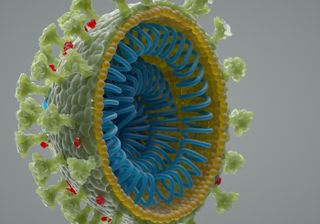
Kristian Andersen, an associate professor of immunology and microbiology at Scripps Research, and his colleagues looked at the genetic template for the spike proteins that beetle from the surface of the virus. The coronavirus uses these spikes to grab the outer walls of its host'due south cells and and so enter those cells. They specifically looked at the gene sequences responsible for two key features of these fasten proteins: the grabber, chosen the receptor-binding domain, that hooks onto host cells; and the so-called cleavage site that allows the virus to open and enter those cells.
That assay showed that the "hook" office of the fasten had evolved to target a receptor on the exterior of human cells called ACE2, which is involved in blood pressure regulation. It is so effective at attaching to human cells that the researchers said the spike proteins were the upshot of natural choice and non genetic engineering science.
Here'south why: SARS-CoV-2 is very closely related to the virus that causes severe acute respiratory syndrome (SARS), which fanned across the earth nearly 20 years ago. Scientists have studied how SARS-CoV differs from SARS-CoV-2 — with several fundamental alphabetic character changes in the genetic code. Still in computer simulations, the mutations in SARS-CoV-2 don't seem to work very well at helping the virus demark to human being cells. If scientists had deliberately engineered this virus, they wouldn't accept chosen mutations that computer models advise won't piece of work. Merely information technology turns out, nature is smarter than scientists, and the novel coronavirus found a fashion to mutate that was improve — and completely different— from anything scientists could accept created, the study found.
Another boom in the "escaped from evil lab" theory? The overall molecular structure of this virus is distinct from the known coronaviruses and instead near closely resembles viruses found in bats and pangolins that had been piffling studied and never known to cause humans whatsoever harm.
"If someone were seeking to engineer a new coronavirus as a pathogen, they would take constructed it from the backbone of a virus known to cause illness," according to a statement from Scripps.
Where did the virus come from? The inquiry group came up with two possible scenarios for the origin of SARS-CoV-2 in humans. One scenario follows the origin stories for a few other recent coronaviruses that have wreaked havoc in homo populations. In that scenario, we contracted the virus directly from an animal — civets in the case of SARS and camels in the case of Centre Due east respiratory syndrome (MERS). In the case of SARS-CoV-2, the researchers suggest that animal was a bat, which transmitted the virus to another intermediate creature (possibly a pangolin, some scientists have said) that brought the virus to humans.
Related: 20 of the worst epidemics and pandemics in history
In that possible scenario, the genetic features that brand the new coronavirus and so effective at infecting human cells (its pathogenic powers) would have been in place before hopping to humans.
In the other scenario, those pathogenic features would have evolved only after the virus jumped from its animal host to humans. Some coronaviruses that originated in pangolins accept a "hook construction" (that receptor bounden domain) similar to that of SARS-CoV-2. In that fashion, a pangolin either direct or indirectly passed its virus onto a human being host. Then, once inside a man host, the virus could have evolved to have its other stealth characteristic — the cleavage site that lets information technology hands break into human cells. Once it adult that capacity, the researchers said, the coronavirus would be even more capable of spreading between people.
All of this technical detail could aid scientists forecast the future of this pandemic. If the virus did enter human cells in a pathogenic form, that raises the probability of future outbreaks. The virus could nonetheless exist circulating in the animal population and might again jump to humans, ready to cause an outbreak. But the chances of such futurity outbreaks are lower if the virus must outset enter the human population and and then evolve the pathogenic properties, the researchers said.
Coronavirus science and news
- Coronavirus in the US: Map & cases
- What are the symptoms?
- How deadly is the new coronavirus?
- How long does virus last on surfaces?
- Is there a cure for COVID-19?
- How does information technology compare with seasonal flu?
- How does the coronavirus spread?
- Can people spread the coronavirus after they recover?
Originally published on Alive Science .
- The nine Deadliest Viruses on Earth
- 28 Devastating Infectious Diseases
- 11 Surprising Facts Nearly the Respiratory System
Source: https://www.livescience.com/coronavirus-not-human-made-in-lab.html
0 Response to "We Know"
Post a Comment