ground meat is safe to serve at what internal temperature servsafe
In commercial foodservice, understanding food rubber temperatures is crucial to protecting your guests from foodborne illness. All operators and nutrient handlers are responsible for recognizing the importance of the temperature danger zone and should be educated to perform established food safe procedures. Proceed reading to learn all about the food temperature danger zone, how long food can safely stay in the danger zone, and the food safe temperature range for hot and cold food.
Shop All Kitchen Thermometers
Click below to learn about the temperature danger zone:
- Why Is the Danger Zone Important?
- How Long Food Tin can Stay in the Danger Zone
- How to Hold Cold Food
- How to Agree Hot Food
- Prophylactic Cooking Temperatures
- How to Apace Absurd Hot Foods
- Cold Food Storage Times
What Is the Danger Zone?
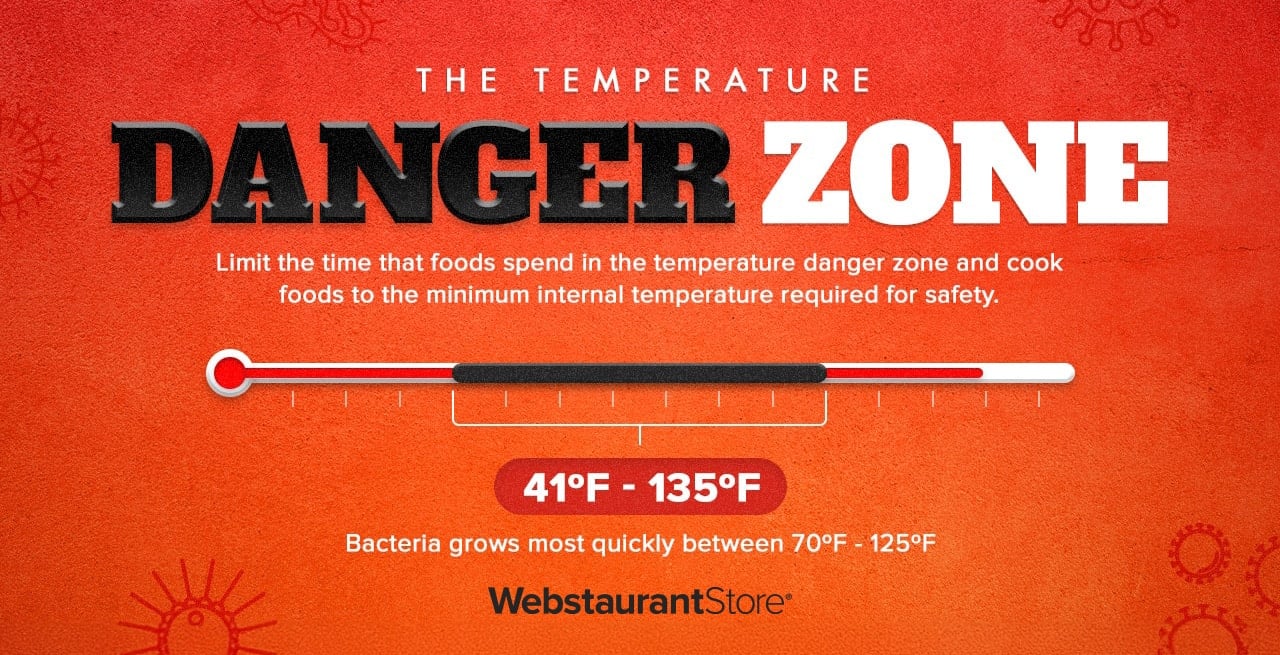
The danger zone refers to the temperature range in which bacteria growth occurs most rapidly on food. According to ServSafe recommendations, food temperatures betwixt 41 and 135 degrees Fahrenheit represent this danger zone. Bacteria tin multiply at whatsoever temperature inside the danger zone, simply temperatures between 70 and 125 degrees Fahrenheit provide the most hospitable environment for bacteria to thrive. The longer food sits in the temperature danger zone, the greater the risk that leaner volition grow on the food.
Why Is the Temperature Danger Zone Of import?
When foods are allowed to enter the temperature danger zone, bacteria may grow to unhealthy levels and cause the nutrient to spoil. Dangerous bacteria growth like this may occur without whatsoever visible signs that the nutrient is dangerous for consumption. Foods may smell and announced normal, only could actually contain harmful amounts of bacteria that volition crusade foodborne illness.
This is what makes the temp danger zone extremely important. As a food service professional, it's your responsibility to continue foods out of the danger zone by using approved methods to chill, oestrus, and shop foods.
What Is Time Temperature Abuse?
Fourth dimension temperature abuse is the deed of assuasive foods to stay in the temperature danger zone of 41 to 135 degrees Fahrenheit. Along with cantankerous-contamination, time temperature abuse is a common source of foodborne illness. Foods may become time-temperature abused in three ways:
- Foods are not held or stored at nutrient safe temperatures
- Food is not cooked or reheated to the temperature required to eliminate possible pathogens
- Hot food is not cooled properly earlier being placed in cold storage
What Are TCS Foods?
TCS stands for time/temperature control safety. Foods that require strict time and temperature control are considered TCS foods. Pathogens dear TCS foods because they present an platonic environment for germs to abound and spread. Preventing TCS foods from entering the danger zone and becoming fourth dimension-temperature abused is a disquisitional food safety practise. These are the high-risk TCS foods that should be closely monitored at all times:
- Milk and dairy products
- Meat and poultry
- Fish, shellfish, and crustaceans
- Vanquish eggs
- Baked potatoes
- Cooked rice, beans, and vegetables
- Tofu, soy protein, or other plant-based meat alternatives
- Sprouts and sprout seeds
- Cut tomatoes, melons, and leafy greens
- Untreated garlic and oil mixtures
Dorsum to Top
How Long Tin can Food Stay in the Temperature Danger Zone?
ServSafe states that 4 hours is the maximum length of fourth dimension ready-to-eat foods tin can stay in the temperature danger zone. Subsequently the 4 hr limit, foods must be thrown away. Within the 4 hour time limit, foods tin can be consumed, reheated, or chilled to bring them back to food safe temperatures. Checking temps every 2 hours allows for a greater window to perform any corrective actions that are necessary.
How to Keep Nutrient Out of the Danger Zone
Kitchen thermometers are the central to keeping foods out of the temp danger zone. By monitoring and recording food temperatures regularly, you can prevent foods from condign time-temperature driveling. This is imperative while prepping, cooking, and holding nutrient on your cafe line or salad bar.
Follow these of import tips to ensure you're making the best use of your kitchen thermometers to keep nutrient prophylactic for consumption.
- Always use the right type of thermometer for the job.
- Never rely on the temperature display of your equipment alone.
- Place a thermometer within your refrigerator or freezer as an additional safety measure.
- Continue a written record of all temperature checks that includes the temp, the time, and the name of the operator.
- Clean and calibrate thermometers often.
Back to Top
Food Belongings Temperature
One time your food is cooked to the proper internal temperature or chilled to 40 degrees Fahrenheit or below, it's important to maintain these prophylactic temperatures before serving. There are a number of instances in which foodservice professionals need to concur food for extended periods of times. These instances could include holding food in salad bars and buffet lines or transporting food to off-site locations and catering events.
When transporting nutrient, it is recommended y'all use a food pan carrier or insulated catering bag to ensure your hot or common cold foods remain safety for consumption.
Cold Holding Temperature
The cold holding temperature for TCS foods must be at xl degrees Fahrenheit or below. Hither are some tips to properly concur common cold foods and so they don't fall into the danger zone:
- Ensure your cold-property equipment keeps foods at forty degrees Fahrenheit and beneath.
- Any cold food held without refrigeration is rubber for upwards to vi hours, starting from the time it was removed from refrigeration at forty degrees Fahrenheit and below.
- Check the temperature of cold foods every 2 hours and discard any cold food that reaches a temperature of 70 degrees Fahrenheit or higher.
How Cold Does a Salad Bar or Fridge Have to Be to Keep Nutrient Prophylactic?
Salad confined and refrigerators need to maintain temperatures at 40 degrees Fahrenheit and below to prevent the growth of unsafe leaner. This is especially important every bit you house vulnerable TCS foods including cheese, yogurts, meats, salad dressings, and egg products.
Holding Temperature For Hot Food
The appropriate holding temp for hot foods is 135 degrees Fahrenheit or above. Here are some tips to keep hot foods out of the danger zone:
- Never use hot holding equipment to reheat food. Foods should be heated to safe temperatures prior to holding. Hot belongings equipment is designed to maintain current temps, not bring nutrient up to temp.
- When possible, keep nutrient covered to assist maintain temperatures and keep contaminants out.
- Stir frequently to distribute heat throughout the nutrient.
- Use the appropriate thermometer to monitor food temperatures frequently.
- Discard hot food that has been sitting beneath 135 degrees Fahrenheit for more than 4 hours.
- Never mix freshly prepared food with foods already beingness held for service to foreclose cross contamination.
How Frequently Should I Bank check the Temperature of Hot or Cold Holding Food?
It is recommended you check the temperature of your hot or cold holding food every four hours. All the same, if you check every 2 hours instead, this allows plenty time to take corrective activity in the event that food has fallen into the danger zone. Past staying on top of your nutrient's internal temperatures, yous tin forbid the spread of dangerous bacteria and eliminate food waste by simply re-heating or re-spooky the affected foods before bacteria has fourth dimension to spread.
Back to Top
Safe Cooking Temperatures
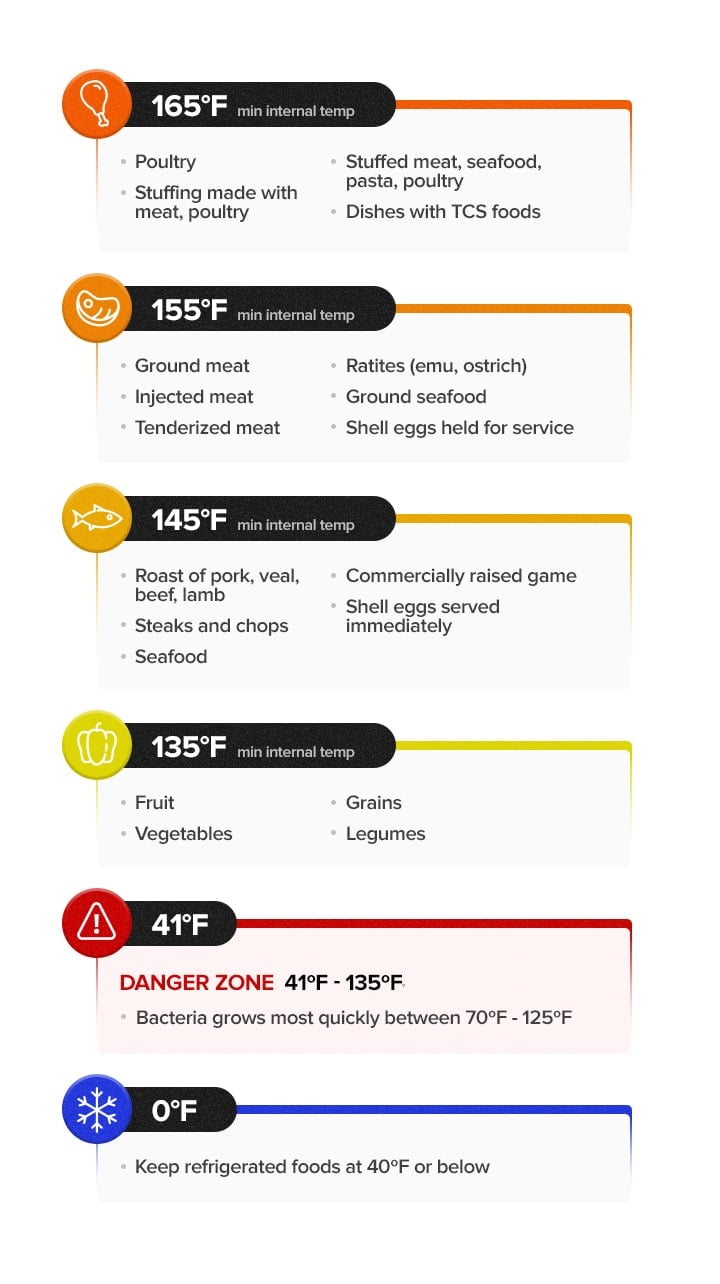
To forestall the spread of salmonella, staphylococcus aureus, listeria, and other dangerous bacteria, it'south of import to monitor the internal temperature of the foods yous serve. Follow the recommendations below for safe cooking temperatures of common TCS foods.
Cook to 165 degrees Fahrenheit for at to the lowest degree xv seconds:
- Poultry, whole or basis
- Stuffing made with poultry, meat, or fish
- Blimp pasta, meat, poultry, or seafood
- Any dish that contains a cooked TCS nutrient
Cook to 155 degrees Fahrenheit for at least 15 seconds:
- Footing beefiness, pork, or other meats
- Season-injected meats
- Tenderized meats
- Ratites (ostrich, emu)
- Basis, chopped, or minced seafood
- Eggs from the shell, held for service
Cook to 145 degrees Fahrenheit for at to the lowest degree 15 seconds:
- Seafood
- Steaks and chops (beef, pork, veal, lamb)
- Commercially raised game
- Eggs from the crush, served immediately
- Roasts of beefiness, pork, veal, lamb (must be cooked for at least 4 minutes)
Cook to 135 degrees Fahrenheit (no minimum time):
- Fruits
- Vegetables
- Rice, pasta, and other grains
- Legumes
Click below to print a visual reminder of the safe cooking temperatures listed to a higher place:
Printable Version
Back to Elevation
What Exercise You lot Need to Know About Resting Time for Meats?
Before taking temperatures, it'southward important to notation the rest fourth dimension of meat required when removing information technology from the grill, oven, or other rut source. During this time, the temperature will remain consistent or proceed to rise. This process helps to destroy harmful germs.
How Do You Speedily Absurd Hot Foods?
Many institutions and large commercial kitchens prepare dishes ahead of time for maximum efficiency in their kitchen. The food is so cooled downwards and held until service. When doing this, information technology's of import to absurd the food rapidly and safely then that information technology doesn't linger in the danger zone for too long.
If y'all're preparing food alee of fourth dimension, you must bring the temperature down to forty degrees Fahrenheit or beneath within two hours of striking its proper internal temperature.
Tips for Cooling Hot Foods to Nutrient Prophylactic Temperatures
Placing hot food directly into your refrigerator or freezer is never recommended considering information technology endangers the food around it by raising the ambience temperature in your fridge or freezer. This creates the possibility of other foods in your refrigerator or freezer entering the temperature danger zone and developing bacteria without yous fifty-fifty knowing. Instead, follow these tips for quickly cooling your hot foods.
- Use a commercial nail chiller to cool foods rapidly and minimize the time nutrient spends in the danger zone.
- Store foods in shallow containers to allow the temperature to distribute more evenly.
- Consider using a cooling paddle to reduce the temperature of hot liquids including soups, stews, and sauces.
- Create an ice bathroom by filling a pot, container, or sink basin with ice. Containers of hot foods can be placed in the ice bath to quickly cool nutrient to 40 degrees Fahrenheit or below.
Learn more about bringing foods down to temperature in our cooling foods guide.
Cold Food Storage
In improver to belongings and serving cold foods, it's important to know how long you can shop common cold foods earlier they become dangerous for consumption. Always date characterization your refrigerated foods and utilize a first-in, starting time-out (FIFO) system. Use this chart equally a reminder of how long items can be safely kept before they must be discarded.
| Nutrient Item | Fridge (40°F) | Freezer (0°F) |
|---|---|---|
| Bacon | one week | 1 calendar month |
| Beverages | 3 weeks unopened, 7-x days opened | eight-12 months |
| Cheese - difficult (Swiss) | 3-4 weeks | six months |
| Cheese - soft (brie) | 1 calendar week | vi months |
| Craven, egg, macaroni, and tuna salad | 3-iv days | Practice not freeze |
| Cottage cheese | 1 week | Practice not freeze |
| Dough - cookie | Utilise by appointment | 2 months |
| Dough - tube cans of rolls, biscuits, pizza dough | Use by appointment | Do not freeze |
| Egg substitutes - opened | three days | Do not freeze |
| Egg substitutes - unopened | three days | 1 year |
| Eggs - fresh in shell | 3-5 weeks | Do not freeze |
| Eggs - difficult cooked | ane week | Practice not freeze |
| Fish - fatty (salmon) | ane-2 days | two-3 months |
| Fish - lean (cod) | 1-2 days | 6 months |
| Footing meats - raw | 1-two days | 3-4 months |
| Ham - fully cooked, slices | three-4 days | 1-2 months |
| Ham - fully cooked, whole | i week | 1-two months |
| Hot dogs - opened | ane calendar week | one-two months |
| Hot dogs - unopened | 2 weeks | 1-two months |
| Luncheon meats - opened | 3-five days | 1-2 months |
| Lunch meats - unopened | 2 weeks | one-2 months |
| Margarine | 4-5 months | 12 months |
| Mayonnaise - opened | 2 months | Do not freeze |
| Milk | 1 week | 3 months |
| Poultry - cooked | 3-four days | ii-6 months |
| Poultry - fresh, chicken or turkey | 1-two days | 6 months |
| Prepared leftovers | three-iv days | 2-three months |
| Sausage - raw | i-two days | i-2 months |
| Sausage - cooked | 1 week | 1-two months |
| Steaks, chops, and roasts - raw | 3-5 days | four-6 months |
Back to Tiptop
Information technology'southward every food service operator's tiptop priority to keep the food they're serving prophylactic for consumption. Following these important tips and guidelines volition ensure your managers and staff have the knowledge to keep food out of the danger zone, have corrective action, and continue customers rubber from harmful foods.
Source: https://www.webstaurantstore.com/article/29/following-food-safety-temperatures.html
0 Response to "ground meat is safe to serve at what internal temperature servsafe"
Post a Comment